
Formula 1 cars are some of the most expensive racing machines ever built. You’ve got carbon fibre everywhere, advanced aerodynamics, hybrid power and technology that changes almost every season. But here’s the big question. How much does an F1 car actually cost in rupees ?
So here’s the deal. There isn’t an official showroom price for a current F1 car because teams don’t sell them like normal cars. A complete modern F1 machine can represent well above ₹100 crore in specialised hardware and technology, while the full cost of developing and racing it is much higher.
F1 Car Price in Rupees 2026
Let me give you a rough idea of the numbers involved. These are estimates because Formula 1 teams don’t publish a simple price tag for every part of the car.
| F1 Cost | Approx Price in Rupees |
| Complete Modern F1 Car | ₹100 crore to ₹150 crore+ |
| Power Unit Package | ₹200 crore+ per team package |
| Carbon Fibre Chassis | Several Crore Rupees |
| Front Wing | ₹1 crore+ depending on design |
| Steering Wheel | Tens of Lakhs |
| Historic F1 Car | ₹10 crore to ₹100 crore+ |
Now here’s where it gets interesting. Formula 1’s 2026 team cost cap is $215 million for covered expenses, which is roughly around ₹1,900 crore depending on exchange rates. That isn’t the price of one car though. It covers many costs linked to developing, manufacturing, testing and racing the team’s cars during the season.
Why Does an F1 Car Cost So Much ?
An F1 car isn’t built on a normal production line. Almost every major part is designed around racing performance, low weight and speed.
Teams spend huge amounts developing tiny improvements because even a small gain can make the car faster. Better aerodynamics, lighter parts and improved cooling can all affect lap times.
And unlike a normal road car, the design keeps changing during the season. That’s where the real money starts adding up.
F1 Engine Price in Rupees
The engine is one of the most expensive systems in the entire car. Modern Formula 1 cars use highly advanced hybrid power units rather than a simple petrol engine.
Under the current regulations, the maximum 2026 power-unit supply price is €22 million for the defined team supply package. That’s well above ₹200 crore at typical recent exchange rates, although this covers the season’s supply package rather than one single engine.
So when you hear someone say an F1 engine costs a certain amount ? Remember that the real team package includes much more than one engine sitting in one car.
2026 F1 Power Unit
The 2026 Formula 1 cars use a new generation of hybrid technology. The basic idea is still a turbocharged V6 engine combined with electric power, but electricity now plays a much bigger role.
That means more electronics, battery technology and energy management. All of this needs specialist engineering and expensive materials.
The result ? Huge performance from a very compact package, but also a huge development bill.
F1 Carbon Fibre Chassis
The chassis is basically the heart of the car. It’s made from carbon fibre composite material to keep weight low while still protecting the driver.
This isn’t normal carbon fibre trim like you’d see inside a sports car. The entire survival structure has to meet strict racing safety standards.
Designing and building it takes specialised equipment and a lot of engineering work. A single chassis can therefore represent several crore rupees in value once development and manufacturing are considered.
F1 Front Wing Price
The front wing might look like a simple piece of carbon fibre. Trust me, it isn’t.
It controls how air moves around the entire car. Teams spend a huge amount of time testing different shapes and setups.
Damage one during a race ? The team may need to replace it almost immediately.
A modern front wing can represent around ₹1 crore or more depending on the design and how development cost is counted.
F1 Steering Wheel Price
An F1 steering wheel looks more like a game controller than a normal steering wheel. It’s packed with buttons, switches, paddles and a digital display.
Drivers can control many things from it, including:
- Gear changes
- Brake settings
- Differential settings
- Radio
- Energy management
- Pit functions
- Display settings
- Car modes
All that technology comes at a price. A Formula 1 steering wheel can cost tens of lakhs of rupees depending on the design and electronics involved.
F1 Brakes
Formula 1 brakes work under extreme conditions. They need to slow the car from huge speeds again and again without losing performance.
Teams use advanced carbon materials for the discs and pads. Cooling also matters because brake temperatures can become extremely high.
So this isn’t the kind of brake system you’d find on a normal sports car. It’s lighter, more powerful and far more expensive.
F1 Gearbox
The gearbox is another major piece of engineering. Drivers change gears using paddles behind the steering wheel and shifts happen incredibly quickly.
The gearbox has to handle huge loads while staying light and compact. That makes manufacturing difficult and expensive.
Teams also need spare parts throughout the season. One gearbox problem can affect an entire race weekend.
F1 Suspension
An F1 suspension system isn’t built mainly for comfort. It’s designed to keep the tyres working properly while controlling the car at very high speeds.
Every part needs to be light and strong. Suspension geometry also affects aerodynamics.
That means teams don’t just buy a suspension kit and bolt it on. They design the whole system around the car.
More engineering ? More money.
How Fast Is an F1 Car ?
An F1 car can easily go above 300 km/h on the right circuit. But top speed isn’t what makes it truly special.
The real magic happens in corners.
F1 cars produce huge aerodynamic downforce. That lets them carry much more speed through corners than normal road cars.
Then there are the brakes. An F1 car can slow down incredibly quickly.
That’s why comparing an F1 car with a supercar using only top speed doesn’t tell the whole story.
How Much Does an F1 Team Spend ?
This is where the numbers become crazy.
Formula 1’s 2026 cost cap is $215 million for covered team spending. That’s roughly around ₹1,900 crore depending on currency rates. The regulations cover costs linked to areas such as development, manufacturing, testing and racing, although some expenses remain outside the cap.
And that’s for the team operation. Power-unit manufacturers work under their own separate financial rules too.
So the real cost behind two F1 cars on track ? Much bigger than simply adding up the physical parts.
Is One F1 Car Really Worth ₹100 Crore ?
You can think of ₹100 crore to ₹150 crore or more as a rough estimate for the physical machine and its extremely specialised components. But there’s no official retail price.
Why ? Because development changes everything.
Imagine a front wing takes months of simulation and wind-tunnel work. The carbon fibre part itself has one manufacturing cost, but the engineering behind it costs much more.
The same applies to the chassis, suspension and other parts. That’s why different estimates give different numbers.
F1 Car vs Supercar Price
A supercar is expensive, but it’s still a production vehicle. You can buy a Ferrari or Lamborghini, register it and drive it on public roads.
An F1 car is completely different. It’s a racing prototype designed around one championship’s regulations.
A premium supercar may cost ₹4 crore to ₹10 crore or more. An F1 car can represent many times that amount once its specialist hardware is considered. And development costs ? Not even close.
Can You Buy an F1 Car in India ?
You can’t walk into a dealership and order the current Ferrari or McLaren F1 race car.
Current cars belong to the teams and are closely controlled. But older F1 cars sometimes appear at auctions. Collectors can also buy show cars and replicas.
A show car may look almost identical to the real thing but may not have a working Formula 1 engine. Historic race-used cars are a different story. Those can become extremely valuable.
Historic F1 Car Price in Rupees
Historic Formula 1 car prices depend heavily on their story.
Was it driven by a world champion ? Did it win races ? Is the original engine still there ? All of that matters.
Some older F1 cars can cost ₹10 crore to ₹20 crore. Famous race-winning examples can reach ₹50 crore, ₹100 crore or even more at international auctions. At that point you’re not just buying a car. You’re buying motorsport history.
F1 Show Car Price
A show car is usually much cheaper than a real race-used Formula 1 car.
It is mainly designed for display. You might see one at a brand event, showroom or exhibition. Some have realistic bodywork and cockpits but don’t have a functional race power unit.
Want something that looks like an F1 car in your collection ? A show car makes much more sense than trying to own a current race machine.
Can You Drive an F1 Car on Indian Roads ?
Not really.
A Formula 1 car is built for race circuits. Ground clearance is extremely low, the steering is very sensitive and the tyres need the right conditions to work properly.
Then you’ve got speed breakers. Potholes. Traffic. Normal parking ramps. An F1 car would hate all of them. It also isn’t built to meet normal road-car registration requirements.
Want to drive one properly ? You need a circuit.
F1 Car Maintenance Cost
Buying an F1 car would only be the beginning.
These machines need specialist engineers, equipment and replacement parts. The power unit, gearbox, brakes and electronics all require expert support. You can’t exactly take one to your local workshop.
Other costs can include:
- Transport
- Specialist mechanics
- Racing tyres
- Replacement parts
- Fuel
- Storage
- Electronics support
- Engine maintenance
- Track fees
- Insurance
So even an older running F1 car can cost a fortune to operate.
Which Part of an F1 Car Costs the Most ?
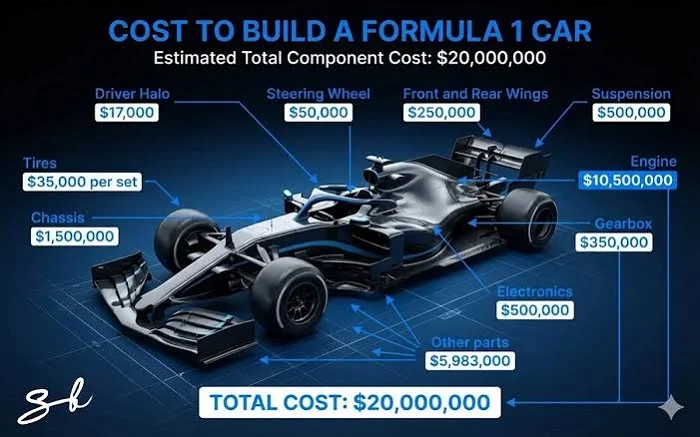
The power unit is one of the biggest costs, but the answer isn’t as simple as picking one part. The chassis is expensive. The gearbox is expensive. Aerodynamic development is expensive too.
And here’s the important bit. Research and development can cost far more than physically making a component.
That’s why looking only at replacement-part prices doesn’t show the real cost of Formula 1.
Also Read: Car Price in India Below 5 Lakhs 2026: Best Budget Cars & Buying Guide
Is an F1 Car Worth Buying ?
For a normal buyer ? Not really.
You can’t use it as a daily car and maintaining it is extremely difficult. Even starting and operating some older F1 cars requires specialist support.
For collectors though ? Completely different story. A historic Ferrari, McLaren or championship-winning car can be an incredible piece of motorsport history.
But you need serious money and the right facilities.
What Should You Check Before Buying ?
If you’re actually looking at an old Formula 1 car, history matters more than almost anything else.
Check these things:
- Chassis number
- Team history
- Driver history
- Race history
- Original engine
- Gearbox
- Original bodywork
- Service records
- Spare parts
- Running condition
- Import costs
- Storage needs
And get a motorsport specialist involved. This isn’t the kind of purchase you inspect like a normal used car.
Questions People Ask
1. What Is the F1 Car Price in Rupees ?
A modern Formula 1 car can roughly represent ₹100 crore to ₹150 crore or more in specialised hardware and technology, but there is no official retail price.
2. How Much Does an F1 Engine Cost in Rupees ?
There isn’t a simple price for one engine. The 2026 regulated power-unit supply package can cost up to €22 million for a team, which is well above ₹200 crore at typical recent exchange rates.
3. Can I Buy an F1 Car in India ?
Current race cars aren’t normally sold to private buyers, but historic F1 cars, replicas and show cars can sometimes be purchased.
4. Why Is an F1 Car So Expensive ?
The price comes from advanced engines, carbon fibre, aerodynamics, electronics, safety technology and huge research and development costs.
5. Is an F1 Car More Expensive Than a Lamborghini ?
Yes. A modern F1 car can represent far more money than a normal Lamborghini once specialised parts and technology are considered
The F1 car price in rupees doesn’t have one exact number because current Formula 1 cars aren’t sold as normal retail vehicles. A modern machine can roughly represent ₹100 crore to ₹150 crore or more in specialised hardware, while the development and racing costs behind it are far higher.
The engine, chassis, aerodynamics and electronics all cost serious money, but research and development is where the numbers really explode. So when you see an F1 car on track, you’re not just looking at an expensive racing car. You’re looking at hundreds of engineers and an operation that can involve thousands of crores of rupees across a season.